



A mid-shift failure on a legacy Reliance Electric GV3000 AC drive forces finance leaders and plant managers into an immediate legacy equipment capital decision. Approving a warrantied board-level repair restores production fast, while funding a modern variable frequency drive (VFD) retrofit removes long-term obsolescence risk at the cost of cabinet modifications, PLC logic edits, and extended integration downtime.
CFOs and plant managers should base the legacy equipment capital decision on failure root cause, downtime exposure, and parts obsolescence, accounting for full installed scope beyond the price of a replacement drive. A warrantied board-level repair restores shift output quickly while keeping legacy parts and skill constraints in place. A full VFD retrofit eliminates platform obsolescence, though cabinet modifications, communication card swaps, and PLC validation extend integration downtime.
- Isolate internal drive failures from external electrical or mechanical faults before approving repair or retrofit spending.
- Use repair as a temporary bridge, with explicit spending limits or a scheduled retrofit cutover.
- Require motor-loaded dynamic testing and a written root-cause report before returning a repaired drive to service.
Key Takeaways for Capital Allocation
Evaluating an aging drive means balancing immediate recovery speed against multi-year operational risk across the production line. Strong capital requests tie maintenance findings directly to lost throughput, safety compliance, and total installed cost.
- Prioritize replacement when an asset acts as a single point of failure, drives recurring unplanned stops, or sits on a line with several years of remaining mechanical life.
- Compare a repair invoice against the full installed retrofit scope, including panel rework, mounting brackets, communication adapters, and control software edits.
- Audit the connected powertrain first, since swapping a failed drive or motor without testing upstream wiring, cooling airflow, and mechanical load exposes the repaired hardware to repeat damage.
- Use a warrantied board-level refurbishment as a scheduled bridge when immediate shift recovery matters most and engineering needs turnaround lead time for a planned retrofit.
Comparing a component repair quote against a full capital expenditure (CapEx) replacement requires looking well past the distributor price of a new drive. Ripping out an obsolete GV3000 cabinet assembly introduces physical and software integration work: technicians must fabricate new backplane mounting brackets, re-terminate power and control wiring, swap communication cards, and rewrite programmable logic controller (PLC) ladder logic. Plant teams that treat a tripped VFD as an isolated electronics swap often pull the chassis, drop in a replacement power module, and bolt the unit back into the enclosure without checking the line. If a grounded motor lead or seized roller bearing caused the spike, energizing that repaired drive exposes the new components to immediate repeat failure and wastes the maintenance budget.
Quantifying the Cost of Inaction and Extended Downtime
In any repair-versus-retrofit model, time to recovery heavily skews the financial math. Unplanned VFD outages drain plant budgets well beyond the vendor invoice. In large industrial plants, unplanned downtime costs manufacturers upward of $100,000 per hour once lost output, scrap, and recovery labor are tallied. According to Global Electronic Services, which repairs Reliance drives including the GV3000 series, a stalled production line incurs idle labor costs, emergency repair expenses and contractual penalties alongside lost production revenue.
- Idle labor costs: Operators, maintenance technicians, and shift supervisors still draw wages for scheduled hours while the line sits idle. Reassigning crews to secondary tasks limits dead time, though pulling workers off their primary stations often disrupts adjacent production schedules.
- Emergency repair expenses: Expedited air freight for replacement parts, premium rates for emergency field service calls, and technician overtime hours quickly multiply the baseline repair bill.
- Contractual penalties: Missed delivery windows can trigger service-level chargebacks and late-shipment penalties under customer supply agreements. Those deductions cut directly into operating margins on completed runs.
- Lost production revenue: Work-in-process stalled mid-cycle may have to be scrapped or requalified, and scheduled output that cannot be recovered through overtime shifts permanently reduces sales revenue.
Chronic drive faults also destabilize plant scheduling and downstream supply commitments. When maintenance technicians spend shift after shift clearing the same overcurrent or DC bus fault codes, preventive work on other critical assets falls behind. Missed shipment dates force downstream buyers to adjust their own assembly schedules and qualify alternative suppliers, turning an unresolved drive issue into permanent account attrition.
Evaluating Obsolescence Risk, Parts Supply, and Labor Gaps
For a CFO evaluating whether to keep an aging asset on the books, supply chain friction and internal skill gaps represent concrete balance-sheet risks. Because Rockwell Automation discontinued the Reliance Electric GV3000 line years ago, locating original equipment manufacturer (OEM) gate-driver cards, power interface boards, or specialized semiconductors often requires searching established surplus stock or verifying an engineering-vetted equivalent. Delays in component sourcing quickly extend production outages when a legacy drive goes down. Keeping critical spare parts or a tested spare drive on hand can shorten recovery from a multi-day outage to a single two-hour swap.
Sourcing replacement boards is only half of the recovery challenge. Maintenance staff also need platform-specific expertise to check hardware revision compatibility, adjust regulator boards, and verify the repaired unit under load. Many facilities face widening skill gaps as veteran electricians retire: according to Limble’s State of Maintenance Report, 74% of maintenance organizations had a critical asset that only one employee on staff knew how to fix, and 47% had already lost unrecoverable tribal knowledge when experienced workers left.
A number that doesn’t change a decision within the year, on a machine that isn’t sticking around, is a distraction with a price tag.
Matt Moseman, Founder and President, DEVELOP LLC, in Power & Motion, 2026
Regulatory compliance also shapes the cost of maintaining legacy equipment. Reinforcing structured maintenance and condition assessment, the National Fire Protection Association’s 70B electrical maintenance standard took effect in January 2023. That update shifted NFPA 70B from an advisory recommended practice to an enforceable standard that mandates documented Electrical Maintenance Programs (EMPs) and regular condition testing.
Auditing the Connected Powertrain Before Approving Spend
Authorizing a board-level repair only protects capital if maintenance teams eliminate the electrical or mechanical fault that triggered the breakdown. Swapping a blown insulated-gate bipolar transistor (IGBT) module, gate-driver board, or input rectifier on the repair bench restores the drive’s internal circuitry, yet it does nothing to correct an external short or thermal overload on the plant floor. Bolting a refurbished GV3000 back into an enclosure fed by loose supply lugs, line voltage transients, or a grounded motor stator subjects the fresh power stage to repeat failure upon startup.
Before signing off on either a repair purchase order or a full CapEx retrofit, plant engineering teams must isolate internal component degradation (such as a shorted IGBT bridge or dried-out electrolytic bus capacitors) from protective trips caused by upstream utility power or downstream mechanical loads:
- Motor: A symptom that appears at the motor often originates at the drive output stage, or vice versa. Phase-to-phase insulation breakdown in the motor windings, shorted motor leads, or unbalanced output voltage across terminals U/T1, V/T2, and W/T3 can trigger instantaneous overcurrent (OC) trips or damage the IGBT inverter stage. Replacing the motor or the drive in isolation rarely resolves an underlying phase or insulation fault.
- Wiring: Loose terminal lugs, corroded ground paths, or deteriorated supply cables disrupt power delivery and cause low DC bus voltage (LU) trips or voltage spikes that resemble control board failures. A 2023 Electrical Safety Foundation International (ESFI) article reported that 25% of surveyed facility professionals cited faulty internal wiring or connections as a primary cause of facility power surges, ahead of lightning strikes at 22%.
- Cooling: Clogged enclosure filters, dust-coated heatsinks, or a stalled cooling fan push the drive past its thermal limit and trigger a controller overtemperature (OH) fault. Prolonged heat exposure also accelerates electrolyte evaporation inside the DC bus capacitors, which turns a basic airflow restriction into permanent board damage.
- Connected machinery: A jammed conveyor, seized roller bearing, or overloaded gearbox forces the motor to draw excess current and triggers an overload (OL) or overcurrent (OC) trip. Similarly, decelerating a high-inertia load too rapidly feeds regenerative energy back into the drive and trips a high DC bus voltage (HU) fault. In these cases, the GV3000 is functioning properly by shutting down to protect the powertrain.
Hands-on familiarity with the GV3000 architecture allows a technician to cross-reference stored fault logs against the active regulation mode, whether the unit is configured for Flux Vector control or General Purpose Volts/Hertz (V/Hz) operation. Inspecting acceleration and deceleration ramp parameters (P.001 and P.002) alongside motor current traces shows whether a trip stems from an aggressive stopping profile or a failing power component, giving finance leaders hard evidence before they commit capital.
A Capital Decision Framework for Finance and Operations Leaders
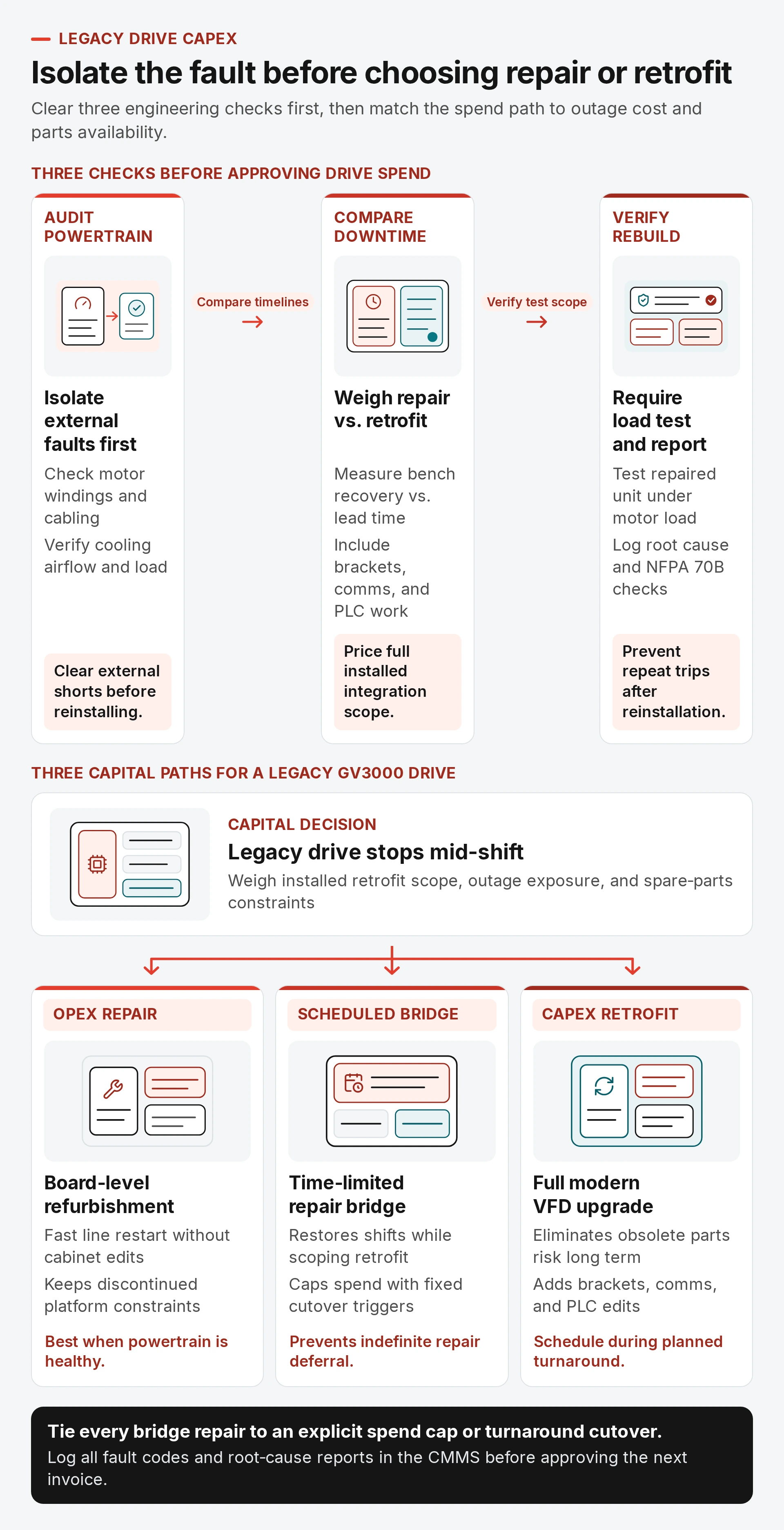
When an aging drive halts production, finance leaders and plant managers can structure the repair-versus-replace analysis around operational failure modes, obsolescence exposure, and recovery timelines instead of relying on a single lifecycle formula.
Evaluating Repair as a Time-Limited Bridge to a Planned Retrofit
Framing the capital decision as a strict binary between immediate replacement and indefinite repair overlooks a practical third path: using a warrantied component repair as a scheduled bridge. Funding a board-level refurbishment gets the line running within days while engineering scopes the replacement drive, orders long-lead adapter kits, and schedules installation for a planned maintenance shutdown. To keep a temporary bridge from turning into permanent deferral, CFOs should attach clear exit triggers to the repair approval, such as capping total annual repair spend at a fixed percentage of replacement cost or mandating cutover at the next semiannual plant turnaround.
1. Compare Turnaround Schedules Against Integration Downtime
Refurbishing a legacy GV3000 drive typically returns a line to service much faster than engineering a full retrofit from scratch, provided the repair shop supports the Reliance Electric product line. Global Electronic Services reports that it completes most Reliance drive repairs within five business days, with one-to-two-day rush service available for urgent breakdowns, though exact schedules depend on the GV3000 catalog number and parts required. Operations teams should obtain a formal repair timeline after initial bench diagnostics and compare that recovery window directly against the lead time needed to source a modern drive, modify cabinet backplanes, swap communication cards, and validate updated PLC logic.
2. Vet Vendor Inventory and Preventive Refurbishment Scope
Predictable turnaround times require a repair partner with stocked Reliance components and dedicated test benches. Before issuing a purchase order, verify that the vendor holds high-wear parts in inventory for the drive’s exact horsepower and voltage rating, including cooling fans, electrolytic DC bus capacitors, and IGBT modules, and confirm that 24/7 rush support covers night and weekend shifts. A thorough rebuild scope pairs on-site checks of motor insulation, power cabling, enclosure cooling, and mechanical load with full preventive refurbishment at the depot. Bench technicians should safely discharge and test the DC bus, inspect gate-driver and regulator circuits, replace all aging electrolytic capacitors and fans alongside the failed components, and back the completed assembly with a clear warranty.
3. Require Closed-Loop Load Testing and Root-Cause Documentation
Experiencing a repeat trip immediately after reinstalling a drive erodes confidence in maintenance budgets. Static multimeter checks on a workbench cannot replicate the thermal and electrical stress of an industrial motor under load. Require the repair vendor to test the refurbished GV3000 under closed-loop motor load across its full speed and torque range to verify balanced output waveforms and thermal stability. Finance and maintenance leaders should also require a written root-cause failure report detailing which internal components failed and why, pairing those bench findings with on-site inspections under NFPA 70B guidelines before energizing the cabinet.
Repair, scheduled bridge, or full VFD retrofit: how the three paths compare
| Decision factor | Board-level repair | Scheduled repair bridge | Full VFD retrofit |
|---|---|---|---|
| Recovery timeline | Often completed in five business days, with one-to-two-day rush options depending on catalog number | Fast restart via depot repair while engineering prepares cutover for a planned turnaround | Longest outage due to drive lead time, cabinet fabrication, rewiring, and PLC testing |
| Budget and accounting | Lower upfront invoice; typically treated as current-period operating expense (OpEx) | Bounded OpEx bridge paired with a pre-approved CapEx budget for planned cutover | Higher upfront capital expenditure (CapEx), capitalized and depreciated over useful life |
| Integration and cabinet scope | Drops back into existing cabinet, mounting brackets, wiring, and PLC program | Zero immediate cabinet rework; integration engineering runs offline before turnaround | Requires backplane brackets, power and control re-termination, comms cards, and PLC edits |
| Obsolescence and parts risk | Keeps discontinued platform on the floor; relies on surplus stock or vetted equivalents | Contains obsolescence risk behind an explicit spend cap or fixed turnaround cutoff date | Removes discontinued-drive dependency and restores OEM parts and firmware support |
| Skill and NFPA 70B exposure | Remains dependent on model-specific GV3000 troubleshooting knowledge and EMP testing | Uses documented root-cause findings and CMMS logs to schedule an orderly transition | Broadens technician support pool while still requiring NFPA 70B condition testing |
| Best fit | Isolated internal component failure with healthy motor, wiring, and mechanical load | High-downtime production line needing fast restart ahead of a scheduled shutdown | Recurring failures, severe parts scarcity, or a host machine with multi-year remaining life |
What finance leaders should verify before signing the purchase order
Accounting treatment often skews how plant requests compete for funding. Component-level drive repair restores existing equipment to working condition and usually hits current-period maintenance expense (OpEx), whereas a full VFD retrofit extends useful life and is capitalized as CapEx. That budget split can tempt teams to approve repeated repairs that look smaller on this quarter’s income statement while costing more in cumulative downtime.
Before approving spend on either path, ask engineering for four concrete numbers on one page. Confirm whether the root-cause audit cleared the upstream wiring, cooling, and driven machinery. Review rolling 12-to-24-month repair spend on the drive against the full installed retrofit quote, including brackets, comms cards, and PLC programming. Check the remaining mechanical life of the motor and gearbox the drive controls, and write an explicit spend cap or turnaround deadline into any bridge repair order.
Aligning Plant Maintenance Logs With Capital Budgets
Capital requests stall when maintenance logs and finance spreadsheets track different realities. For wider context, our guide to predictive analytics in business decision-making discusses equipment maintenance forecasts and financial planning; it does not replace a drive-specific condition assessment. If plant electricians clear three high-bus-voltage trips a week without logging the lost minutes in the computerized maintenance management system (CMMS), the CFO sees a zero-cost legacy asset while the shop floor bleeds throughput. Require technicians to log every drive fault code, reset delay, and megohmmeter insulation reading against the specific asset ID before approving the next repair invoice. Tying bench root-cause reports directly to line-item downtime costs gives leadership a clearer financial picture to evaluate repair limits and schedule the retrofit.
Frequently asked questions
How fast is a board-level VFD repair compared with a full drive retrofit?
Depot board-level refurbishment often restores a line within five business days, and one-to-two-day rush service is available when urgent breakdowns hit. A full retrofit keeps the line down longer because technicians must source the replacement drive, fabricate mounting brackets, update communication cards, and test edited PLC ladder logic.
What powertrain checks should engineering finish before approving drive spend?
Engineering should inspect motor winding insulation and leads, tighten power and ground terminations, verify enclosure airflow and cooling fans, and check connected conveyors, bearings, and gearboxes for mechanical overloads. Clearing those external triggers prevents a newly repaired or replacement drive from failing on startup.
How can CFOs keep a bridge repair from turning into indefinite deferral?
Attach explicit exit conditions to the repair purchase order. Cap rolling annual repair spend as a share of full installed retrofit cost, or tie the repair approval directly to a scheduled turnaround window with engineering pre-work already funded.
How does OpEx versus CapEx treatment shape a repair-or-retrofit decision?
Board-level repair restores existing capacity and typically flows through maintenance OpEx, while a full VFD retrofit is capitalized as CapEx and depreciated over time. Tracking rolling repair spend alongside hourly downtime losses stops short-term OpEx approvals from masking a higher total cost of keeping an obsolete drive in service.